Showing posts with label environment. Show all posts

Friday, September 08, 2006

"Encyclopedia of Earth" Published Online


"Encyclopedia of Earth" is a comprehensive encyclopedia being collaboratively written by the world's leading experts that addresses all aspects of the Earth's natural systems and their interactions with society. It's sponsored by National Council for Science and the Environment and the Environmental Information Coalition. It's home page has featured articles and authors and provides search and browsing capabilities.

Now, the public site for the "Encyclopedia of Earth"
is now up at http://www.eoearth.org/ . About 200 articles have been reviewed, approved and published and another ~1,000 await review. They have ~200 authors and ~80 editors approved and most of them are still working on it. This week, they will be stepping up the recruitment of new authors and editors and the production on articles. A major 'public' launch of the Encyclopedia of Earth with a few thousand articles is probably 1-2 months away. If you have the expertise, you can sign up on site.
This is both a major new environment resource and proof-of-concept for a new system for authoring and vetting scientific information. The authoring-vetting system uses a private wiki open only to approved authors with review and approval by domain-expert stewards.

Wednesday, September 06, 2006

Economics, Environment and Displays

After yesterday's introductory post about me, I thought a few "insights" were in order. The word “insight” is used as in “concept”, “perception”, “notion”, “conjecture” …you get the idea, anything but well supported theses or facts. So on to the economics, environment and displays.

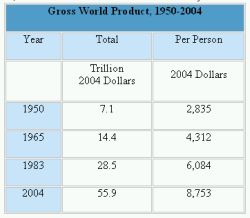
Insight: While discussing terrorism and immigration, it occurred to me that economics may be the basic cause...not, I'm sure, a very original thought. A quick Google search found Gross World Product, 1950-2004 where the doubling time for the GWP was seen to be 15 years after 1950, 18 years after 1965, and 20+ years after 1983...not a very healthy trend! Of course the per capita GWP was substantially worse, doubling in 40+ years. So, on the average, people could look forward to a life time before their wealth doubled.

Think what the world may be like if the doubling time were 10 years, or the 1-2 year doubling time of technology? If rising tides were shared, would we all not have too much to lose for terrorism or emigration to be so central to our lives? How could we bootstrap a dramatically shorter DWP doubling time? The rising educated and middle class in China and India certainly will double world production, probably even within this ten year period. But how can this new wealth penetrate to where the problems are? What if we were to try a system of transfer payments? Let's put money into the dens of terrorists and spawning ground for emigrants; let’s pay them so they can buy goods and services. So they too can become invested in the system and have too much to lose.

Is such an insight beyond belief or simple economics? Economics is devoted to optimum allocation of scarce resources. But what if resources were not scarce? Accelerating technology (a common theme we’ll come back to time and time again) leads to such a short doubling time and to many of the goods and services we will associate with wealth. Digital "products" can be infinitely copied so there can only be artificially cre
ated scarcities. So, if much of our wealth were based on technology and digital goods, we all can be wealthy! We'll return to this theme.

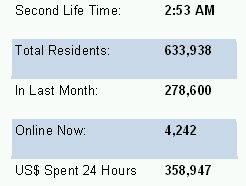
Insight: While we’re on the subject of digital products, let’s jump all the way--into digital worlds and the environment. Many of our environmental concerns have their roots in our living in the “real world “. We move around massive amounts of atoms to do even the simplest things and this costs in energy and physical resources and produces pollution (entropy). Many people are exploring a better way--moving many facets of their lives into digital or virtual worlds. Most of these worlds are themed online games where players found other players and much of their play became centered on living-type activities. A few worlds were open to modification and evolution by “players” and become rich places to live and work. One such world is Second Life (mentioned previously) where life goes on day by day for hundreds of thousands of people worldwide and for hundreds of thousands of US dollars worth of transactions. This will be a main and continuing theme.


Insight: Many smaller, cheaper displays may make a great inexpensive display wall or surround.

Display walls have multiple LCD panels closely abbuting to form multiple images on any subset of panels or one large display, as shown from Septre . Multiple displays are also used to construct surrounds like shown by DigitalTigers or 9XMedia .

Now if these were built from standard LCDs such as an "Acer AL1906AB / 19" / 8ms / 500:1 / SXGA 1280 x 1024 / Black / LCD Monitor ... incorporating the latest LCD technology...$159.99" they would cost under $1000 instead of over two to three times as much. The specific Acer LCD seems to have ½“ bezel so if the bezel can be removed the inter-LCD gap could be about ¼”. If 17” 1280x1024 LCDs were used, the resolution would be about 100ppi at a cost that should be about $100 per panel. Windows XP Professonal already supports up to 10 display controllers and many display controllers can handle four displays. So it would seem possible to construct a wall 40 displays for about $4,000 and control it with 10 controller boards at perhaps $3-500 each. On a smaller scale, a 6 display surround could be under $2,000.



Tuesday, September 05, 2006

Introduction

To start out I thought it would be best to have a little introduction about me and my background. As I've noted in my profile, I consider myself a technologist. And I have the credentials, a PhD in Physics and 40 years working in varied computer applications. Some of my more interesting projects have been in the fields of environment, future forecasting, education, space industrialization, computer-human interface, and emergency response.


A few of my more recent projects are:

Global Environmental Network
C oncept: Solutions to global environmental problems will require the public and decision-makers to understand relevant science. GEN pulls together environmental research, and translates and disseminates it online.
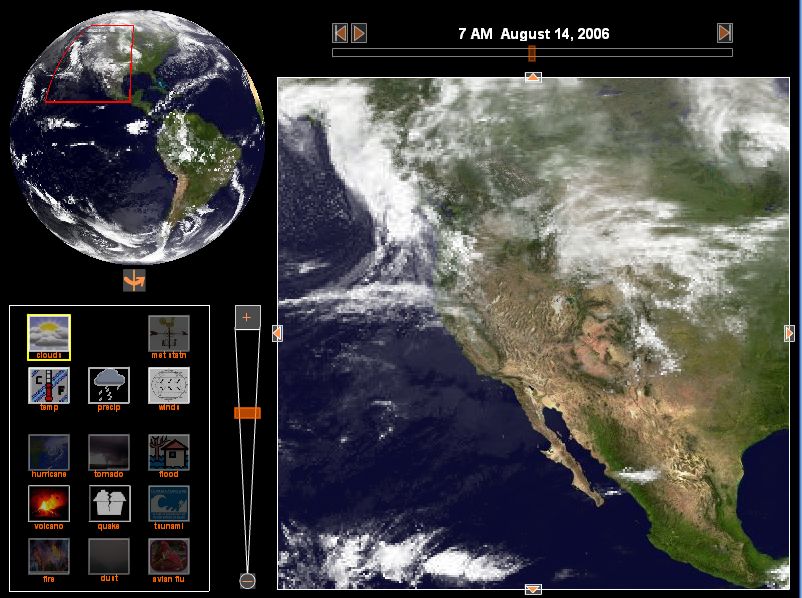
Pe rsonal contribution: Design and programming of demonstration global environmental displays. Developed Flash 3D tiled rotating globe with zoom, pan and multiple levels for data. Integrated data from NOAA global weather simulations, NASA satellites and worldwide disaster reporting into easy-to-explore interface with popup briefs and multi-level windowed links. Worked with academic researchers, government agencies and NGOs to plan project and lead in authoring diverse team proposals.


EzOn Online Photo Album

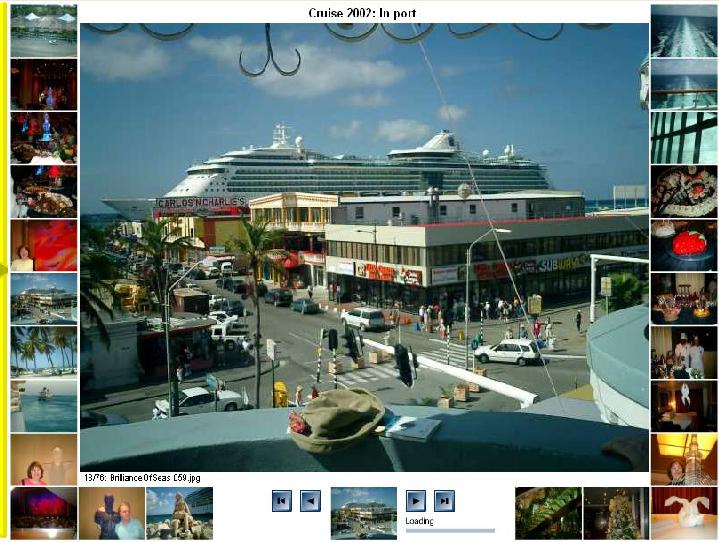
C onc ept: A Web service for uploading and displaying photos had potential but poor esthetic experience. Flash Actionscript was evolving into a browser-based programming language for a far superior user interface.
Pe
rsonal contribution: Mastered successive generations of Actionscript as it went from simple animation tool to full object-oriented language with rich event handling, dynamic messaging and client-server support. Designed, coded and tested multiple generations of interface prototypes and two commercial releases.


iLands
C oncept:
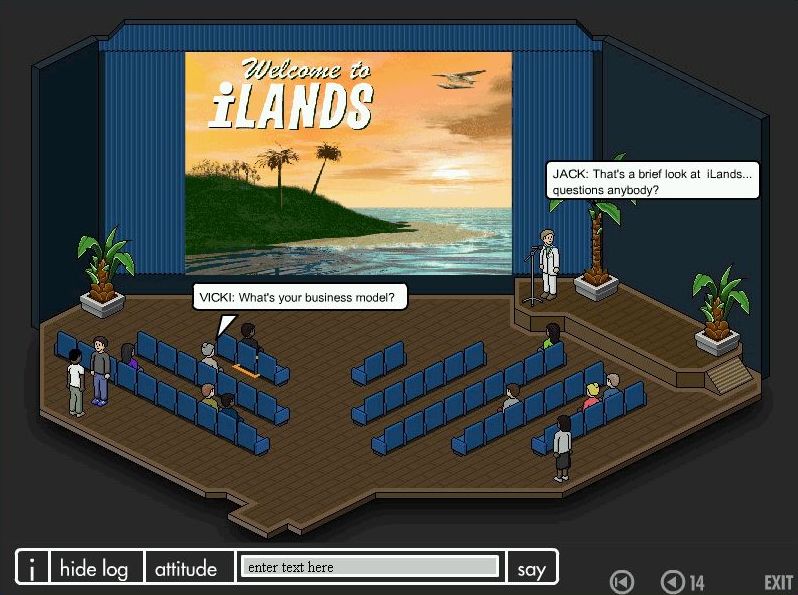
Navigation on the Web is artificial; there are no “places” on the Web. Web sites could be mapped to buildings and similar sites clustered in themed “islands”. The revenue model would be based on real estate.
Personal contribution: Participated in startup and contributed to concept and design, business plan and presentations. Specifically, developed benefits of the virtual environment in terms of social interaction, archiving activities, identity development and inquiry, and mixing synchronous and asynchronous communications.


Most recently my interests have focused on the "Singularity" where accelerating technology becomes our dominant forcing function and virtual (reality) environments such as Second Life, Multiverse and Croquet. The later is a potential response to environmental, resource and economic limits to growth.

Where this blog will go shall unfold day by day. Some of the things I hope to have time for include insights, mine and others, in many of the above fields, such as virtual environments for business in general and emergency response in specific, an inexpensive immersive display system concept, and a possible economic solution for terrorism and emigration.